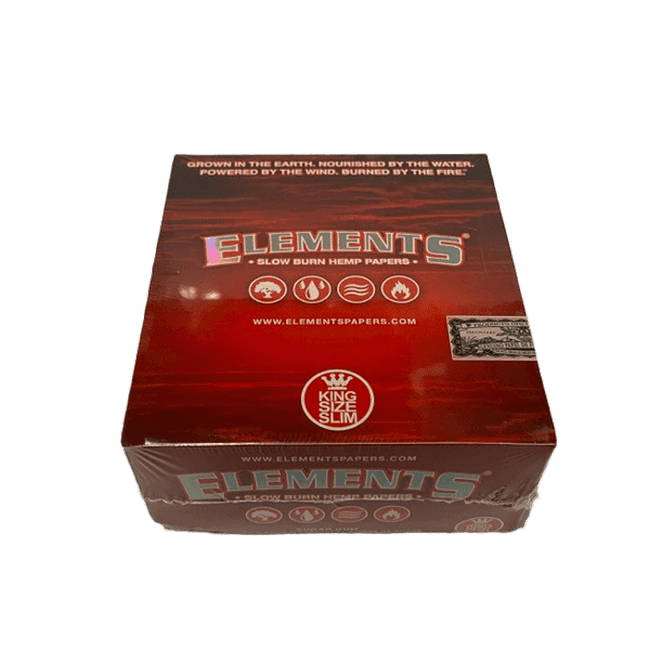
Elements
Elements Slow Burn Hemp Rolling Papers
£30.99
£0.62 each
In stock — dispatched today if ordered by 3pm
Rolling papers from Elements, made in Alcoy in Spain with a natural sugar gum strip and a crisscross watermark. They contain no CBD or other cannabinoid. 18+.
- Free UK delivery on orders over £30
- Third-party lab-tested — COA on every batch
- Discreet plain packaging, no branding outside
- Sold to over-18s only, age-checked at checkout
Elements Slow Burn Hemp Rolling Papers are rolling papers from the Spanish maker Elements, finished with a strip of natural sugar gum and the brand's crisscross watermark. Two things are worth saying before anything else. They contain no CBD and no other cannabinoid, whatever the hemp in the name suggests. And the name itself sits across two different Elements product lines, which is worth understanding before you buy, because those two papers behave differently in the hand.
Hemp paper and rice paper are not the same thing
Elements is best known for a rice paper, and the brand's own description of that line is unusually blunt: no chemicals, no pulp, and no hemp. Rice paper is made from processed rice or rice straw pressed into extremely thin translucent sheets, and it is the thinnest paper on the market.
Hemp paper is a different material entirely. Hemp fibre is pulped and formed into sheets in the ordinary way paper is made, which gives a heavier sheet with visible texture and a warm off-white or tan colour.
Those differences show up the moment you handle them. Rice paper burns slowly because there is so little of it to burn, and contributes almost nothing of its own to the taste, but it tears easily and does not grip well. Hemp paper is more forgiving, grips better, and carries a faint earthy note of its own.
So the slow burn claim belongs to the rice line and the hemp description belongs to the other. Our distributor's product name puts them together, which is a common enough conflation across the trade that at least one retailer sells a product titled as a slow burn hemp paper at a web address describing an ultra thin rice paper.
We would rather set out what each material does than guess which one arrives, and if the material matters to you, the packet itself is the thing to check.
| Rice paper | Hemp paper | |
|---|---|---|
| Made from | Processed rice or rice straw | Pulped hemp fibre |
| Thickness | The thinnest available | Noticeably heavier |
| Appearance | Translucent, near white | Textured, warm off-white to tan |
| Burn | Slowest, very little ash | Steady, more ash |
| Taste of its own | Almost none | Faint earthy note |
| Handling | Tears easily, poor grip | More forgiving, grips well |
There is no CBD in a rolling paper
This needs stating plainly because we sell these alongside cannabidiol products, and because our own listing data has described them in terms that suggest otherwise.
Hemp paper is made from the fibre crop. Fibre hemp is grown for its stalk, and cannabinoids form in the resin glands on the flowers, not in the stalk. By the time hemp fibre has been pulped and pressed into a sheet of paper there is nothing of that kind left in it, and none is added.
Rice paper obviously contains no cannabinoid either, being made of rice.
So neither material carries CBD, CBG or anything else of that nature. If a page anywhere describes a plain rolling paper as a CBD product, that is a cataloguing error rather than a description of the contents. Some makers do sell papers genuinely infused with cannabinoids or terpenes, and those are a different product that says so on the pack.
The watermark, the gum and where they come from
Three details set Elements apart from a supermarket paper, and all three are checkable.
The watermark is the distinctive one. Elements presses a proprietary crisscross pattern into the sheet, which is there to slow and even the burn and to reduce the chance of a run, meaning the burn racing up one side rather than travelling straight across.
The gum line is a thin strip of natural gum derived from sugar rather than a synthetic adhesive. That is a genuine point of difference in a category where the adhesive is usually the least considered part of the product.
And the papers are made in Alcoy, a town in the mountains north of Alicante in Spain. Alcoy has produced rolling papers since the eighteenth century and several of the best known brands still come from there, which is a piece of context nobody selling these bothers to include.
Elements also sells this paper in more than one size, and the number of leaves in a booklet varies with the size rather than being fixed across the range. Check the booklet in front of you rather than assuming.
What we cannot confirm about this listing
Two honest gaps, and we would rather name them than write around them.
The first is the material, covered above. The product name combines the rice line's signature claim with the hemp line's material, and we have not been able to resolve which of the two our distributor ships.
The second is how this is packed. Our records carry a quantity for it, but that figure is flagged in our own system as unconfirmed, so we are not going to repeat it in this description as though it were established. Where a quantity appears elsewhere on this page it comes from the product record rather than from anything we have verified with the distributor.
Neither gap affects what the paper is. Both affect what arrives, which is why they are here rather than buried.
Where papers sit on this site
We stock rolling papers because a good part of our catalogue is hemp and cannabis themed rather than because papers are a cannabidiol product, and it is worth being clear about the distinction.
Some of the papers we carry genuinely are infused, usually with terpenes, and those say so plainly on the pack and in the name. Most, including these, are simply papers.
If you came looking for CBD, the products that carry it are elsewhere: oils that publish milligrams per drop, gummies that publish milligrams per sweet, and vape products that publish milligrams per millilitre. A paper carries none of those figures because there is nothing to measure.
That distinction runs through the whole of this category. When a hemp or cannabis word appears on a product name, the reliable test is whether a milligram figure appears with it. On papers it never does.
Who should not buy these
Anyone expecting a cannabinoid product. There is none here, and the hemp in the name refers to a fibre used to make paper.
Anyone new to rolling by hand, if what arrives is the rice paper. Ultra thin paper is genuinely harder work than a standard one: it tears, it slips, and it does not hold a shape while you are working with it. A heavier hemp or wood pulp paper is much more forgiving to learn on.
Anyone who wants to know precisely what they are getting before it arrives. On the material question and the pack question we have told you what we know and what we do not, and for some people that will be reason enough to choose something less ambiguous.
And anyone who wants flavour from the paper itself. Neither of these materials is flavoured, and the rice version is chosen precisely because it contributes as little as possible.
Frequently asked questions
- Do Elements hemp rolling papers contain CBD?
- No. Hemp paper is made from the fibre crop, which is grown for its stalk, and cannabinoids form in the flower resin rather than the stalk. Once the fibre is pulped and pressed into a sheet there is nothing of that kind left, and nothing is added.
- Are Elements papers rice or hemp?
- The brand makes both, and the name on this listing combines features of each. Elements is best known for a rice paper, and its own copy for that line states it contains no chemicals, no pulp and no hemp. The hemp line is a separate product with a different feel.
- Why are rice papers slower burning than hemp papers?
- Because there is less of them. Rice paper is pressed extremely thin and translucent, so there is simply less material to burn. Hemp paper is a heavier sheet with visible texture, which burns steadily but faster and leaves more ash behind.
- What is the crisscross watermark for?
- It is pressed into the sheet to slow and even the burn and to reduce runs, which is when the burn races up one edge instead of travelling straight across. It is proprietary to Elements and it is one of the few genuine points of design in a rolling paper.
- What is the gum strip made from?
- A thin line of natural gum derived from sugar, rather than a synthetic adhesive. It is an easy detail to overlook, since the adhesive is usually the least considered part of a rolling paper, and it is one of the reasons the brand has the following it does.
- Where are Elements rolling papers made?
- In Alcoy, a town in the mountains north of Alicante in Spain. Alcoy has been making rolling papers since the eighteenth century and remains the origin of several of the best known names in the category, which is context almost no listing bothers to include.
- Are these papers harder to roll than ordinary ones?
- The rice version is, noticeably. It is the thinnest paper made, which means it tears more easily and does not grip the way a heavier sheet does. Hemp paper is considerably more forgiving, which is why it is usually the better choice for anyone still learning.
- How many leaves are in a booklet?
- It depends on the size, since Elements produces this paper in more than one format and the leaf count varies with it rather than being fixed across the range. The booklet itself states the number, and that is the figure to go by.
Updated July 2026
Reviews
No reviews for Elements Slow Burn Hemp Rolling Papers yet. We only publish feedback from people who have actually bought the product, so this stays empty until a real one arrives rather than being filled with anything we made up.
Bought this? Write a review
Write it here and we will check it against your order before it goes up. We publish the critical ones too, so long as they are from a real buyer.
Prefer not to use the form? Send it over instead:
More rolling papers
Papers, cones, wraps, tips