Professor Herb
Professor Herb Herb Pro Dry Herb Vaporiser
£29.99
In stock — dispatched today if ordered by 3pm
A pocket convection vaporiser for dry herbal material, with a 900mAh USB-C battery and a stainless steel chamber. Contains no CBD. 18+ only.
- Free UK delivery on orders over £30
- Third-party lab-tested — COA on every batch
- Discreet plain packaging, no branding outside
- Sold to over-18s only, age-checked at checkout
The Professor Herb Herb Pro is a pocket dry herb vaporiser: a rechargeable device that heats loose plant material until its compounds evaporate, rather than burning it. It contains no CBD and no cannabinoid of any kind, because it is hardware. The specification worth knowing before anything else is that it uses convection heating, which is the less common and more involved way to build a device this size, and not one page selling it explains what that means or why it changes the experience.
Convection, conduction, and why this one is unusual
Every dry herb vaporiser has to solve the same problem: get heat into the material evenly, without setting fire to it. There are two established ways of doing that and they behave quite differently.
Conduction puts the herb in direct contact with a heated surface. The chamber wall gets hot and the material touching it heats up. That is simple to engineer, quick to reach temperature, and easy to make small, which is why the great majority of pocket devices work this way.
The trade-off is evenness. Herb pressed against the wall gets considerably hotter than herb in the middle, so you tend to get some material scorched and some barely touched, and the result is a session that changes character as it goes. Anyone who has emptied a conduction chamber and found a dark ring around the edge and pale material in the centre has seen exactly this.
Convection works the other way round. A separate element heats air, and that hot air is drawn through the herb as you inhale. Nothing sits against a hot surface. The heat arrives from all sides at once, so the material is worked evenly, more of it is used, and the vapour tastes cleaner because nothing has been scorched.
It is a more involved thing to build, which is why compact devices usually do not, and it is genuinely worth knowing that this one does. It also explains the heat-up time of thirty to forty-five seconds, which is slower than a conduction pen and is the mechanism doing its job rather than a shortcoming.
The chamber itself is 316L stainless steel. The grade matters enough to be named: 316L is the marine and medical grade, more resistant to corrosion than ordinary stainless, and it is chosen here for even heat distribution without hot spots. On a device whose whole purpose is avoiding local overheating, that is the right material rather than a marketing detail.
| Conduction | Convection, used here | |
|---|---|---|
| How heat reaches the herb | Direct contact with a heated chamber wall | Hot air drawn through the material |
| Evenness | Uneven, hottest at the wall | Even, heat arrives from all sides |
| Risk of scorching | Material touching the element can scorch | Nothing sits against a hot surface |
| Heat-up | Faster | Slower, around 30 to 45 seconds here |
| Vapour character | Can turn harsh where material has overheated | Cleaner, and the material is used more fully |
| Common in pocket devices | Yes, the usual approach | Less common, more involved to engineer |
The temperature control, and a discrepancy worth knowing about
Here the published descriptions do not agree, so we are going to set out both rather than pick one.
One retailer describes the temperature control as three fixed settings indicated by LED colour: blue for low, green for medium, red for high. That is a common arrangement on devices of this kind and it would mean you choose between three presets rather than setting a number.
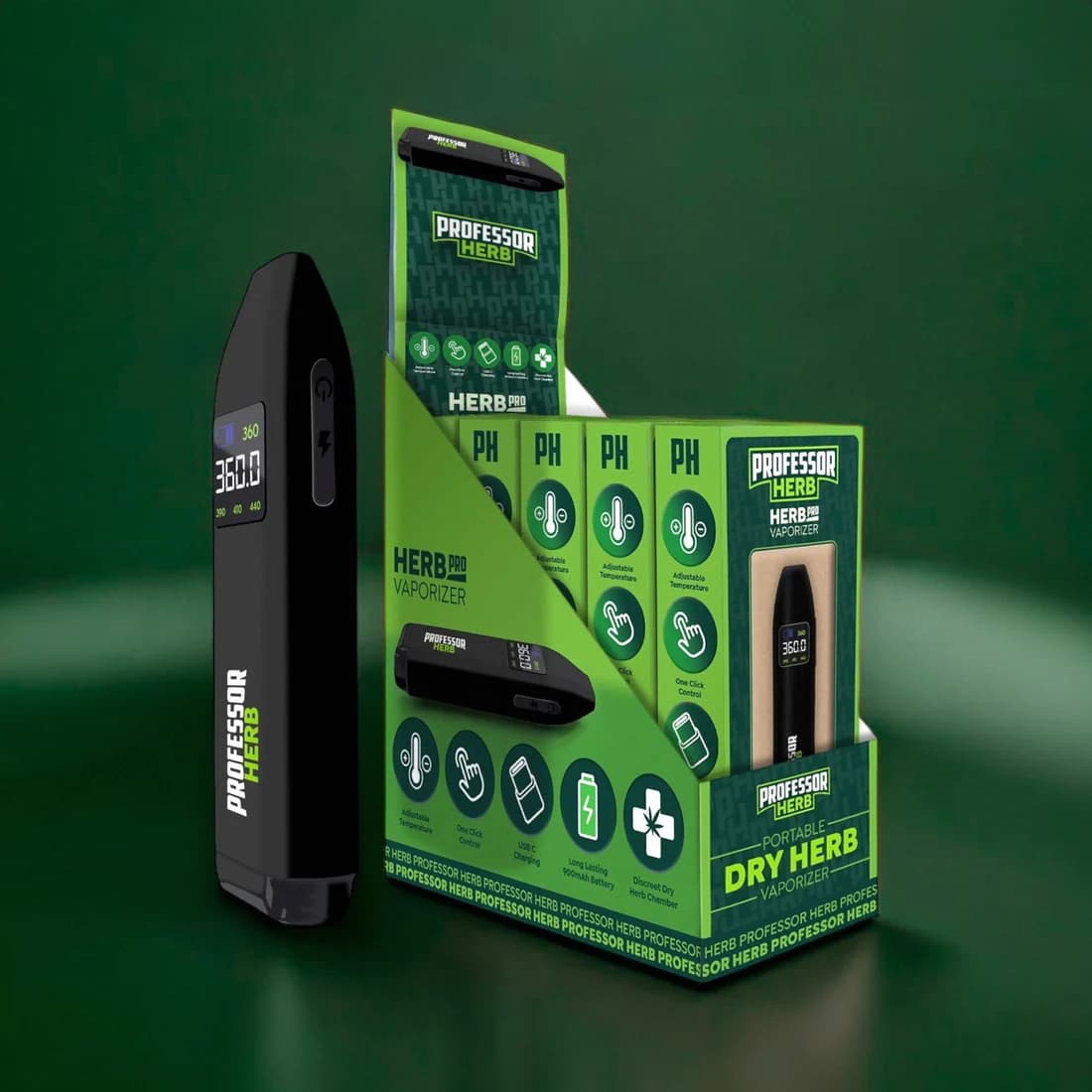
The brand's own product artwork shows something different. The device in it has a small screen reading 360.0, with a scale beside it running up through 380, 400 and 440. Those are Fahrenheit figures, which puts the range at roughly 182 to 227 degrees Celsius.
We cannot reconcile those two descriptions from anything published, and we are not going to assert the numeric range as a specification when our evidence for it is a product render. What we can say is that if you are buying this for precise temperature control, ask us first and we will confirm which version our distributor actually supplies.
The reason the numbers matter at all is worth explaining, because it is the point of the whole device. Plant material combusts at somewhere around 230 degrees Celsius. Above that you are burning it and producing smoke. Below it, the volatile compounds evaporate and you get vapour instead. Every setting on a dry herb vaporiser is chosen to sit under that line, and the 227 degrees implied by the artwork's top setting sits just below it, which is at least internally coherent.
For what it is worth, the range we have published elsewhere for vaporising pressed hemp material is 180 to 200 degrees Celsius, which is around 356 to 392 Fahrenheit. That corresponds to the lower half of the scale shown on the device.
What actually belongs in the chamber
This is the question a first-time buyer of a dry herb device genuinely has, and no listing anywhere answers it. We are in an unusual position to, because we have written up the rest of this brand's range in detail.
The Professor Herb Premium Hemp Blend is the obvious companion, and it is a better fit than most because it arrives finely milled and ready to use. A dry herb chamber wants material broken up enough for air to pass through it evenly, which is exactly what a pre-ground blend gives you. Same brand, and nothing to prepare.
The grinder from the same range is, in this specific pairing, unnecessary. We said as much on its own page: the blend is already milled, and putting it through a grinder reduces it to dust that packs down and draws badly. In a convection device that matters more than usual, because the whole mechanism depends on air being able to move through the material. Dust defeats it.
Pressed hash is the one to be careful about. A briquette or a solid extract softens as it warms and will run down into the chamber and the airpath rather than staying where you put it, which makes a mess that is genuinely difficult to clean out of a small device. Some people do use small amounts on top of a bed of herb, but a chamber designed for loose material is not designed for something that melts, and we would rather flag it than let you find out.
As for how much: fill the chamber loosely rather than packing it. Packed material blocks airflow, which in a convection device means the hot air cannot get through and you get very little vapour for a lot of effort.
Battery, charging and cleaning
The practical specification, which several listings give in fragments and none gives in full.
The battery is 900mAh, charged over USB-C, and reaches full in around an hour. Published figures put that at eight to ten complete sessions per charge, which is a genuinely useful number and considerably more than the pod devices elsewhere in our range manage, though they are doing a different job.
USB-C is worth calling out because it means the cable is one you already own. Nothing about this needs a proprietary charger.
Cleaning is the part nobody mentions and the part that decides whether a dry herb device is still pleasant in six months. Vaporising plant material leaves resin behind, and it accumulates in the chamber, on the screen and in the mouthpiece airpath. A device that has never been cleaned tastes progressively worse and draws progressively harder, and people usually blame the vaporiser rather than the residue.
The routine is simple. Empty the chamber while it is still warm, when residue is soft rather than set. Brush it out with the tool that comes with devices of this kind, or a small dry brush. Periodically use a cotton bud lightly dampened with isopropyl alcohol on the chamber and mouthpiece, and let it dry completely before the next use. Do not soak any part containing electronics, and do not put anything through it that you would not want to inhale afterwards.
| Specification | Detail |
|---|---|
| Type | Portable dry herb vaporiser |
| Heating | Convection |
| Chamber | 316L stainless steel heating element |
| Battery | 900mAh |
| Charging | USB-C, around 60 minutes to full |
| Sessions per charge | Eight to ten, as published |
| Heat-up time | 30 to 45 seconds |
| Temperature control | Described as three LED settings by one retailer, and as a numeric display in the brand's own artwork. See above |
| Cannabinoid content | None. This is hardware |
| What it takes | Loose dry herbal material, not liquid and not pressed solids |
| Age restriction | 18+ only |
How it differs from everything else in our vape aisle
This is the only dry herb device we stock, and it is worth being clear that it has almost nothing in common with the rest of the aisle.
Every other vaping product we carry works on liquid or distillate: a pod, a cartridge or a bottle of e-liquid, heated by a coil. You buy the cannabinoid already measured, in a sealed unit, and the device's job is to turn it into vapour.
A dry herb vaporiser inverts that. The device carries no cannabinoid at all. You supply the material, so what you get out depends entirely on what you put in, and there is no stated milligram figure anywhere in the process. That is a feature if you want control over what you are using, and a drawback if you wanted a known quantity.
It also means the disposables ban simply does not arise. That legislation is about single-use devices thrown away with their liquid in them. This is a rechargeable device with a refillable chamber and no liquid of any kind.
| Herb Pro dry herb vaporiser | Pod kits and cartridges | |
|---|---|---|
| What you load | Loose dry herbal material, supplied by you | A pre-filled pod or cartridge |
| Cannabinoid in the device | None | Stated by the maker, in milligrams |
| Heating | Convection, hot air through the material | A coil heating liquid or distillate |
| Known quantity | No, it depends what you load | Yes, printed on the pack |
| Consumable | Whatever material you choose | Replacement pods or cartridges |
| Cleaning | Regular, resin accumulates by design | Minimal, the pod is replaced |
Who should not buy this
If you want a measured amount of CBD, this is the wrong device entirely. It carries no cannabinoid and gives no figure, because what comes out depends on what you put in. A pod kit or a cartridge tells you what you are getting.
If you will not clean it, do not buy any dry herb vaporiser. Resin accumulation is not a fault, it is how the format works, and an uncleaned device becomes unpleasant faster than people expect.
If you want to use pressed hash in it, read the chamber section again. It softens and runs, and a small device is difficult to recover from that.
If you need precise temperature control specifically, the published descriptions of this device's controls contradict each other and we would rather you asked us before ordering than guessed.
If you want something that works the instant you press it, a conduction device heats faster. The thirty to forty-five seconds here is the convection mechanism doing what it does.
18+ only, as with everything we sell.
Frequently asked questions
- Is the Herb Pro a conduction or a convection vaporiser?
- Convection, which is the less common choice in a device this size. Instead of pressing herb against a hot chamber wall, a separate element heats air that is drawn through the material as you inhale. Nothing sits against a hot surface, so the material heats evenly, more of it is used and the vapour tastes cleaner than a conduction device typically manages.
- What temperature do the settings on this vaporiser run at?
- The published descriptions disagree, which is worth knowing before you buy. One retailer describes three fixed settings shown by LED colour. The brand's own product artwork shows a numeric display reading 360 on a scale to 440, which are Fahrenheit figures and work out at roughly 182 to 227 degrees Celsius. Ask us and we will confirm which version our distributor supplies.
- Why does a vaporiser not burn the material?
- Because every setting is chosen to stay below the combustion point, which for plant material is somewhere around 230 degrees Celsius. Below that line the volatile compounds evaporate and you inhale vapour. Above it the material burns and you inhale smoke. That single threshold is the reason the whole category exists and the reason temperature control matters.
- Can you use the Professor Herb hemp blend in this vaporiser?
- It is the natural pairing, and better suited than most because it arrives finely milled and ready to use. A convection chamber depends on air moving evenly through the material, which is exactly what a pre-ground blend allows. Fill it loosely rather than packing it down, because packed material blocks the airflow the mechanism relies on.
- Can you put hash in a dry herb vaporiser?
- We would be cautious. A pressed briquette or solid extract softens as it warms and tends to run down into the chamber and airpath rather than staying put, which is genuinely difficult to clean out of a small device. Some people use small amounts on a bed of loose herb, but a chamber built for dry material is not built for something that melts.
- Do you need a grinder for use with this device?
- Not with the pre-ground blend, and using one on it is actively unhelpful. We covered this on the grinder's own page: an already-milled blend put through a grinder becomes dust, which packs down and draws badly. In a convection device that matters more than usual, because the hot air has to be able to pass through the material to work at all.
- How long does the Herb Pro battery last?
- It is a 900mAh battery, and the published figure is eight to ten complete sessions on a charge, with a full charge taking around an hour over USB-C. That is a considerably larger battery than the pod devices elsewhere in our range carry, though those are doing a very different job with a much smaller heating load.
- What is 316L stainless steel and why is the grade named?
- It is the marine and medical grade of stainless steel, more corrosion resistant than the ordinary sort, and it is specified here for even heat distribution without hot spots. On a device whose entire purpose is heating material evenly without scorching any of it, the chamber material genuinely affects how it performs rather than being a specification for its own sake.
- How do you clean a dry herb vaporiser?
- Empty the chamber while it is still warm, when residue is soft rather than set, and brush it out with a small dry brush. Periodically clean the chamber and mouthpiece with a cotton bud lightly dampened in isopropyl alcohol, then let everything dry completely. Never soak any part containing electronics. Skipping this is why devices start tasting bad and drawing hard.
Updated July 2026
Reviews
No reviews for Professor Herb Herb Pro Dry Herb Vaporiser yet. We only publish feedback from people who have actually bought the product, so this stays empty until a real one arrives rather than being filled with anything we made up.
Bought this? Write a review
Write it here and we will check it against your order before it goes up. We publish the critical ones too, so long as they are from a real buyer.
Prefer not to use the form? Send it over instead:
More cbd vapes
Rechargeable pod kits, pods and carts